
UK and Japan Step Up Sanctions on Russia’s Shadow Fleet
[kadence_subtitle]
The UK and Japan have stepped up sanctions against Russia’s shadow fleet. Vessels linked to Russia’s LNG trade are now subject to controls.
The Three Ships Show How Early the Designations Came
The focus of sanctions enforcement is shifting from companies to individual vessels—and it is being applied in advance of those vessels engaging in the relevant trade.
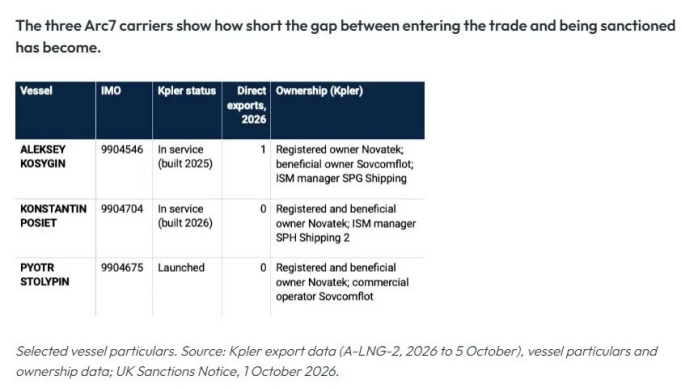
The Aleksey Kosygin (IMO 9904546) had only one recorded direct international export at the time of its listing: it loaded 75,339 tonnes of cargo on 17 July and arrived in Beihai, China, on 9 August. Since January, however, the vessel had been transporting cargo from Arctic LNG 2 to the Saam floating storage facility in Murmansk; such domestic transhipments do not constitute international exports.
When the Pyotr Stolypin (IMO 9904675) was designated by the UK as “potentially involved” in Russian LNG trade, Kpler had no cargo records for it. The Konstantin Posiet (IMO 9904704) was added to the sanctions list before it had carried out any direct cross-border exports
This designation is based not on past transaction records, but on its anticipated role in such trade.
What the UK and Japan Actually Listed
On 1 October, the UK updated its Russia sanctions list, adding 31 new entities. These include eight vessels and Novatek’s Singapore-based chartering platform, Novatek Gas and Power Asia. Among the vessels are three newly built Arc7 ice-class ships: the Aleksey Kosygin, the Konstantin Posiet and the Pyotr Stolypin
Japan followed suit the next day, introducing sanctions targeting vessels and freezing the assets of 33 Russian entities and nine individuals. Japan’s sanctions list covers 35 vessels in total: 27 crude oil tankers, and five ultimately owned by the Russian shipping company Sovcomflot.
According to Kpler data, as of 5 October 2026, the Arctic LNG 2 project had exported approximately 0.95 million tonnes of LNG. All shipments were concentrated after July—nearly double the 0.54 million tonnes exported in all of 2025. The known destinations for all 14 cargoes were in China, with 10 bound for the Beihai LNG terminal.
Why This Fleet Deserves Special Attention
The vessels built by the Zvezda Shipyard, which has been placed on the list, are second-generation Arc7 ice-class ships. They are designed for year-round navigation along the Northern Sea Route and can sail through thick ice to the Arctic LNG 2 project terminal without the need for an icebreaker escort. In contrast, the Azipod pod propulsion systems fitted to first-generation Arc7 vessels, such as the Christophe de Margerie, have long been regarded as a weakness when it comes to winter navigation.
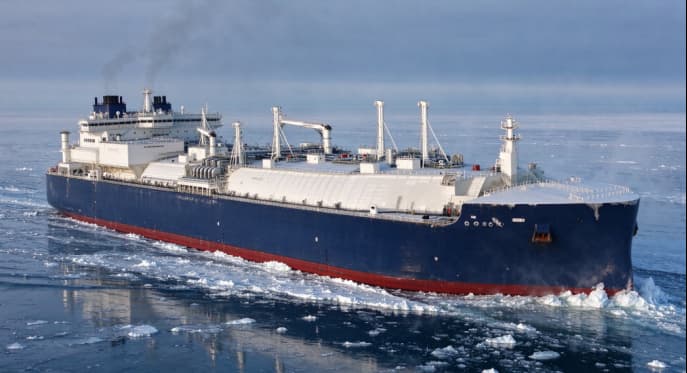
It is difficult to find alternative carrying capacity for this specialised fleet, and the cost of replacement is high—in stark contrast to the large number of ageing, standard oil tankers available for trade in Russian crude. At present, only the Zvezda shipyard in Russia is capable of building Arc7 vessels; Chinese shipyards are the entities outside Russia with the greatest potential to undertake such construction, but their ability to build this type of vessel independently has yet to be proven.
Two Control Plans, One Common Lead
Both countries are working from the same lead—vessels tied to Russian energy shipping—but their targets diverge sharply. Japan’s sanctions focus on oil tankers: its list includes 27 crude oil tankers, four refined oil and chemical tankers, and four general cargo and roll-on/roll-off vessels, five of which belong to Sovcomflot. The UK, meanwhile, has targeted LNG carriers. According to Kpler data, Sovcomflot is the only shipowner to appear on both the UK and Japanese sanctions lists.
The key factor behind the difference in scope is Japan’s reliance on LNG imports from Russia. According to Kpler statistics, between January and September 2026, the Sakhalin-2 project exported a total of 7.12 million metric tonnes of LNG, with nearly half of these shipments destined for Japan; recently, shipments have been concentrated at the Hitachi and Kawasaki receiving terminals. The UK has also issued a specific LNG licence for Japan and South Korea, with a narrow scope and a clearly defined timeframe.
The UK’s ban on the maritime transport of Russian LNG and related insurance services will come into force on 1 January 2027. The EU’s exit clauses for Russian LNG under long-term contracts will also take effect on the same date.