
Turbocompressor & Centrifugal Pump Procurement: A Comparison of API 617, API 610, ISO, and GB Standards
[kadence_subtitle]
Based on their structure, compressors are divided into two main categories: positive displacement and dynamic. Turbine compressors, with rotating blades, a disk, and an impeller, belong to the dynamic type and are mainly divided into centrifugal and axial flow forms. Typical applications include refinery catalytic converter main blowers, ethylene turbines, and long-distance pipeline compressors.
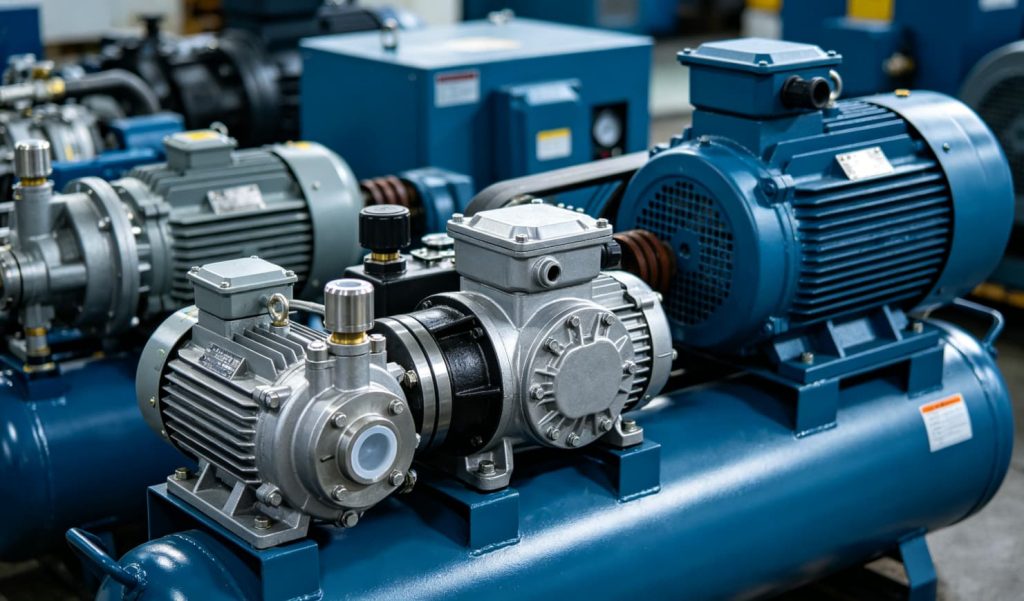
From a structural perspective, pumps can be divided into three categories: rotary dynamic, positive displacement, and other special structures. Centrifugal pumps belong to the rotary dynamic type and are the most widely used pump type in the industry. Centrifugal pumps are commonly used for pipeline oil transfer; a refinery with a capacity of 10 million tons requires approximately 200 pumps of various types, with centrifugal pumps accounting for 83%.
- Applicable Technical Standards for Turbocompressors
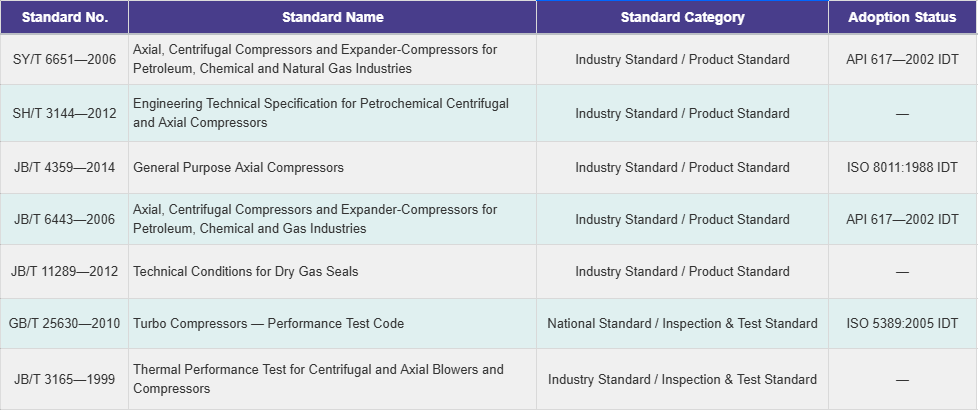
As the table shows, all current turbocompressor product standards are industry-level standards. SY/T 6651 and JB/T 6443 are identical (IDT) to API 617-2002 from the American Petroleum Institute. SH/T 3144 adds extra technical details to API 617-2002 and only applies to centrifugal and axial compressors.
Compared to the older version, API 617-2002 introduced several major upgrades. First, it now covers integrally geared centrifugal compressors and expander-compressors, so three compressor types fall under its scope. Second, the standard is split into four parts: Part 1 has general requirements, and the other three cover each compressor type. On top of that, key technical areas like design, manufacturing, and rotordynamics have been tightened. For example, the required continuous operation time went from 3 years up to 5 years, and the rotordynamics section was significantly expanded.
JB/T 4359 originally came from ISO 8011-1988 (IDT) and is for axial compressors that handle air only. Its rules on special-condition materials, rotor dynamics, and performance testing are more basic than API 617. SY/T 6651 gives a detailed breakdown of shaft end seals, including typical drawings. JB/T 11289 focuses only on dry gas seals, but it applies to both compressors and pumps, with solid requirements for design, production, inspection, and leakage limits.
When a turbocompressor handles process gases, you need shaft end seals to stop gas from leaking along the shaft and to keep the system safe. Common seal types include labyrinth seals, floating ring seals, mechanical seals, and dry gas seals. Dry gas seals are non-contact, so they offer high reliability, no oil contamination, low power use, and long life. That’s why they are the top choice for hazardous gases.
GB/T 25630-2010 is a national standard that matches ISO 5389-2005. It covers performance test procedures and how to evaluate test results for turbocompressors. API 617-2002 accepts ISO 5389 test rules, but ASME PTC-10-1997 is more common in practice. ISO 5389 is an international standard based on ASME PTC-10 and VDI 2045. Its core idea is to use similarity theory for data conversion to check if the equipment meets agreed performance. JB/T 3165 stands alone and is not based on ASME PTC-10. Both standards distinguish between tests using the specified gas versus a substitute gas, but ASME PTC-10 goes into more detail on gas calculations, model conversion, and interstage cooling treatment.
- Technical Standards for Centrifugal Pumps
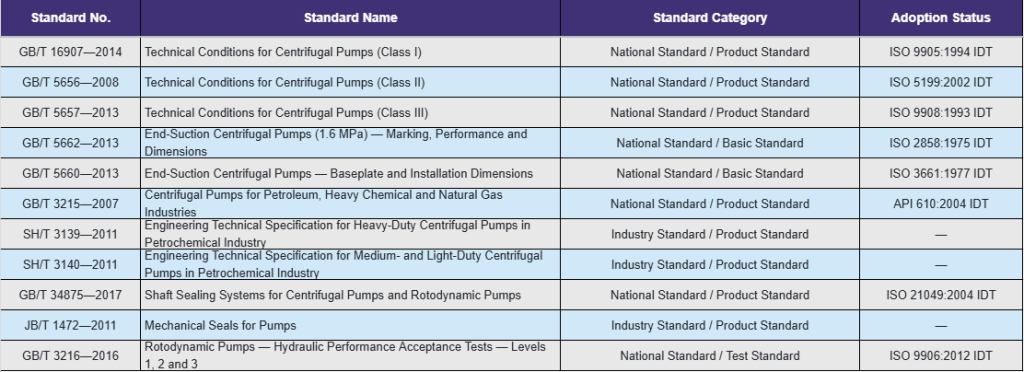
The table shows that GB/T 16907, GB/T 5656, and GB/T 5657 match ISO 9905, ISO 5199, and ISO 9908 respectively. These correspond to three centrifugal pump categories based on reliability and operating conditions. Each category has different design, manufacturing, and acceptance rules: Category I is the most demanding, Category III the least. Category II is the common choice—that’s GB/T 5656-2008 (ISO 5199). This standard references GB/T 5662-2013, GB/T 5660-2013, and GB/T 3216-2016, and covers structural and hydraulic performance testing fully. GB/T 3215-2007 matches API 610-2004, and pumps built to this standard are what people call API centrifugal pumps.
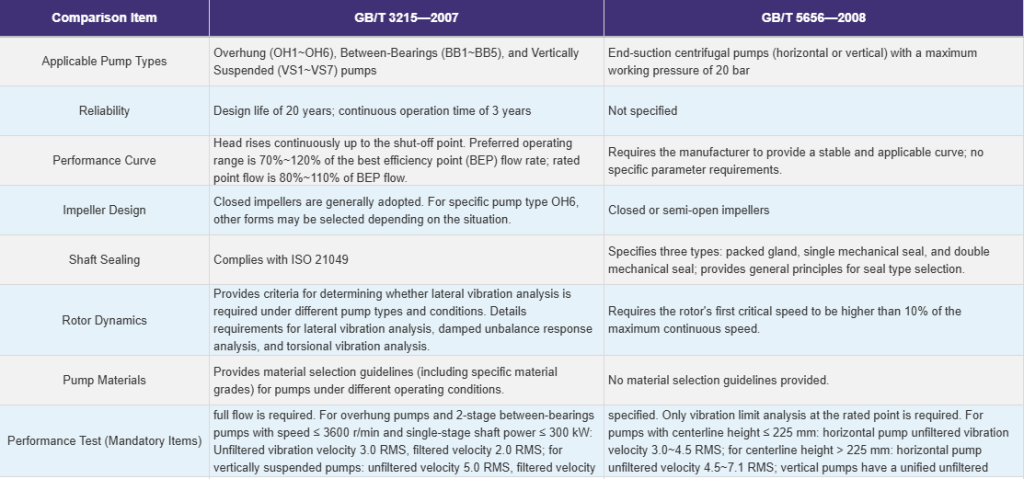
As the comparison shows, GB/T 3215 covers more pump types, has stricter technical requirements, and includes more specific steps for verification. The shaft seal standards ISO 21049 and API 682 are the same, and China’s GB/T 34875-2017 matches ISO 21049-2004, so all three have the same technical content. ISO 21049 (API 682) says the seal cavity should be used within -40 to 400°C, pressure up to 4.2 MPa absolute, and shaft diameter 20 to 110 mm. Seals are split into three categories by size and duty, three types (A/B/C) by design, and three arrangements: single face, unpressurized dual, and pressurized dual. The standard gives detailed guidance on seal selection, materials, and qualification testing to ensure three years of continuous operation. Leakage limits are also clear: for gas, each seal face can leak up to 1000 mL/m³ (measured by EPA Method 21); for liquid, the average leak rate is 5.6 g/h (about 2 drops per minute). By contrast, GB/T 5656 is for pumps with lower maximum operating pressures, gives no specific material or shaft seal guidelines, and mostly uses open-ended language like “meet operating conditions/order requirements.” Its overall technical requirements are much looser.
Studies show that seal leakage goes up as the fluid gets thicker. So the qualification test in ISO 21049 (API 682) is stricter and closer to real-world use. JB/T 1472 seals have a much lower maximum operating temperature than ISO 21049 (API 682) Class I seals, even though pressure limits are similar. If you calculate with 1 ml of water equal to 25 drops, both standards have roughly the same allowable liquid leak rate.
For testing, ISO 21049 (API 682) requires five fluids—water, propane, 20% sodium hydroxide solution, and hot and cold mineral oil—for a full set of static and dynamic tests to confirm seal performance. JB/T 1472 only needs a leakage test with room-temperature water.
SH/T 3140 defines medium- and light-duty centrifugal pumps for petrochemical service. Its criteria are the opposite of the heavy-duty requirements in SH/T 3139. These pumps must follow ISO 5199 plus the extra rules in SH/T 3140.
SH/T 3139 clearly defines heavy-duty centrifugal pumps as those handling flammable or hazardous fluids, or those with any of the following: rated discharge pressure above 1.9 MPa gauge, operating temperature at or above 225°C, rated speed over 3000 r/min, rated head above 120 m, maximum suction pressure above 0.5 MPa gauge, or for cantilever pumps, a maximum impeller diameter over 330 mm. Pumps used in hydraulic recovery turbines are also heavy-duty. All these pumps must meet ISO 13709 (API 610) plus SH/T 3139 extra requirements.
The section above compared different standards. Now let’s look at how to select them. When buying a compressor, you must carefully check any technical deviations between the supplier and the specified standard. For new models, the review should be even tighter. Key items to check include compressor model, aerodynamic design, performance curves, materials, rotordynamics, seal type, and the complete test plan. If the aerodynamic design is already proven in real operation, both sides can discuss deviations based on site conditions and cost. JB/T 4359 is good for refinery catalytic converter main blowers. Standard compressors generally follow SY/T 6651 or JB/T 6443. Both of these industry standards match API 617, so the real decision is which optional clauses in API 617 you choose to apply.
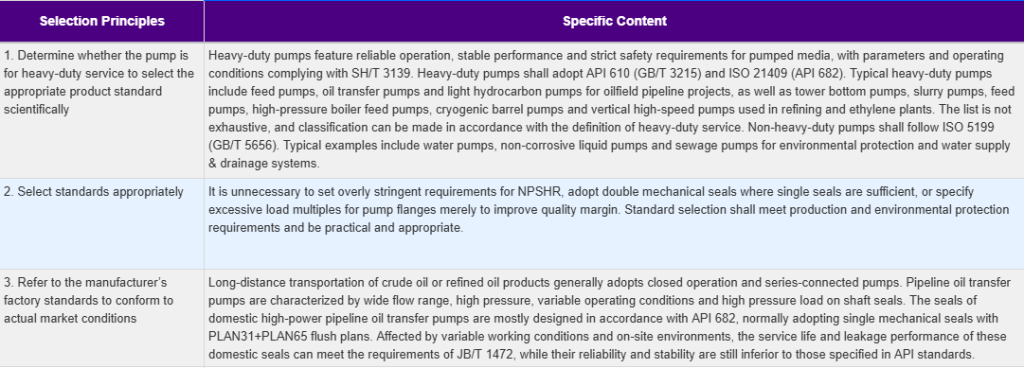
To sum up, choosing technical standards is how the buyer spells out their quality and performance needs. It also gives both supplier and buyer a single reference for manufacturing and acceptance. Different standard levels lead to different equipment quality and procurement cost. Turbocompressors and centrifugal pumps are core equipment in any process plant. In project procurement, you need to balance quality and cost to get good value. The key is to pick the right technical standards based on your actual site conditions.