
A ship repair company completed the centering adjustment of the 115-ton main engine for a cruise ship under way
[kadence_subtitle]
The MAN 14V48/60CR main engine of a cruise ship experienced a severe damage with the alternator coupling. A ship repair company was invited to conduct emergency repairs, strictly adhering to the process of “fault diagnosis – critical operations – fit-up and alignment – commissioning and handover.”
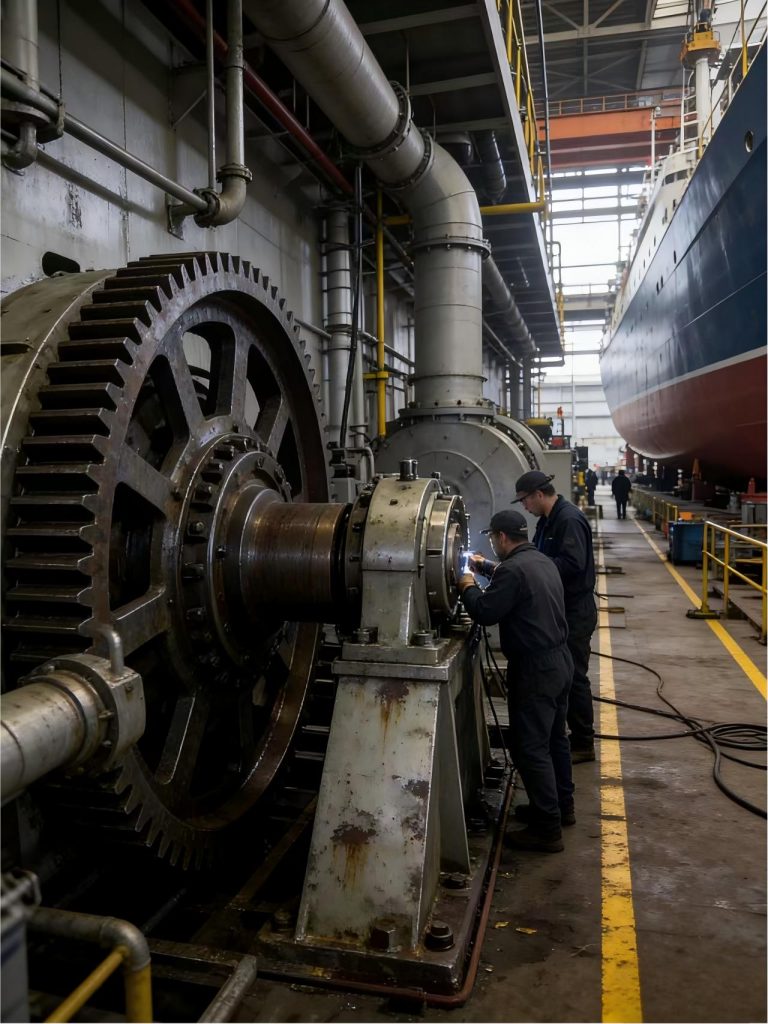
Fault Diagnosis
Upon arrival at the site, their engineers immediately conducted laser alignment testing, which revealed a severe misalignment between the main unit and the alternator, the root cause of the repeated coupling failures. Having identified the root cause, the team determined the core tasks: realigning the main unit and alternator, replacing all 15 flexible rubber supports, re-casting high-performance epoxy gaskets on the critical mounting surfaces of both devices, and installing brand-new couplings.
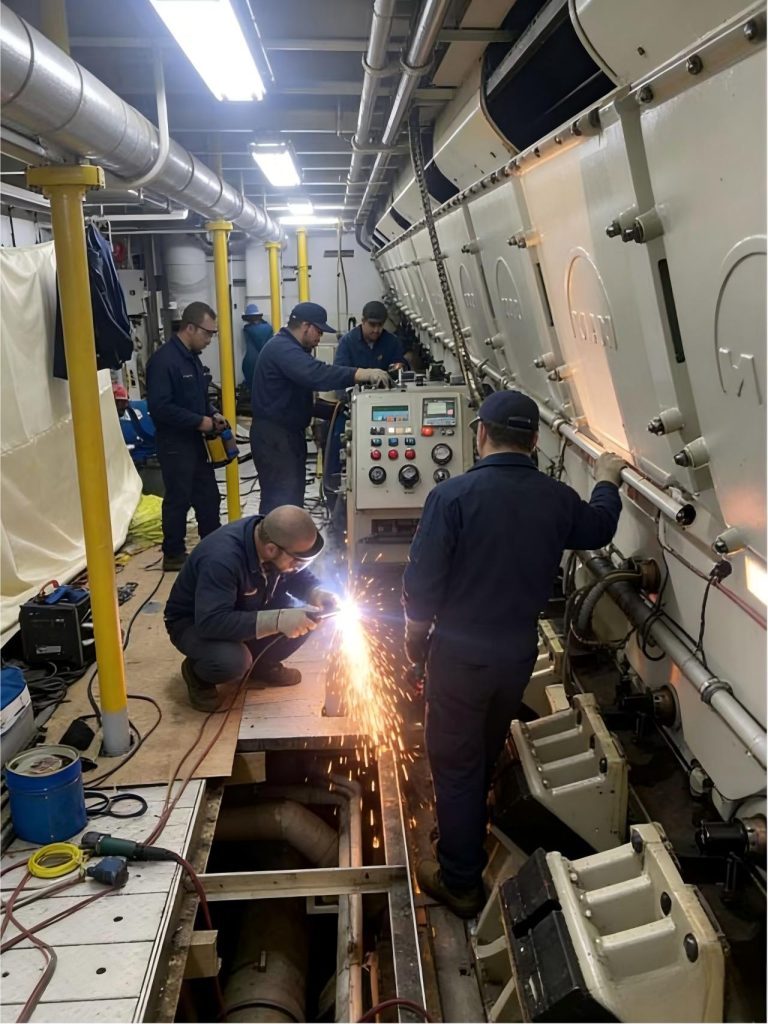
Critical Operation
During the critical operation phase, the ship repair company fully leveraged its internal manufacturing, disassembly, and welding capabilities to systematically advance the alignment adjustments.
Step 1, main unit lifting and alignment: Using six 100-ton jacks, the 115-ton main unit was carefully lifted 15 millimeters to precisely correct the original alignment misalignment with the generator.
Step 2, support replacement and gasket casting: After the main unit was initially positioned, all flexible rubber supports were immediately replaced. Then, Chocfast orange epoxy gaskets were cast under the main unit supports. These gaskets have excellent compressive and impact resistance, ensuring a stable bond between the main unit and the base. A total of 110 sets of these epoxy gaskets, manufactured by ITW Polymers, were used throughout the maintenance process, providing reliable assurance for long-term alignment between the main unit and the generator.
Step 3, generator synchronization: After the epoxy gaskets on the main unit side were fully cured, the generator was precisely aligned and then cast and fixed using high-performance epoxy gaskets to achieve rigid support at both ends.
Step 4,coupling installation: After the main unit and generator were securely installed on the base using the gasket system, a brand-new AC generator coupling was installed, completing the core connection.
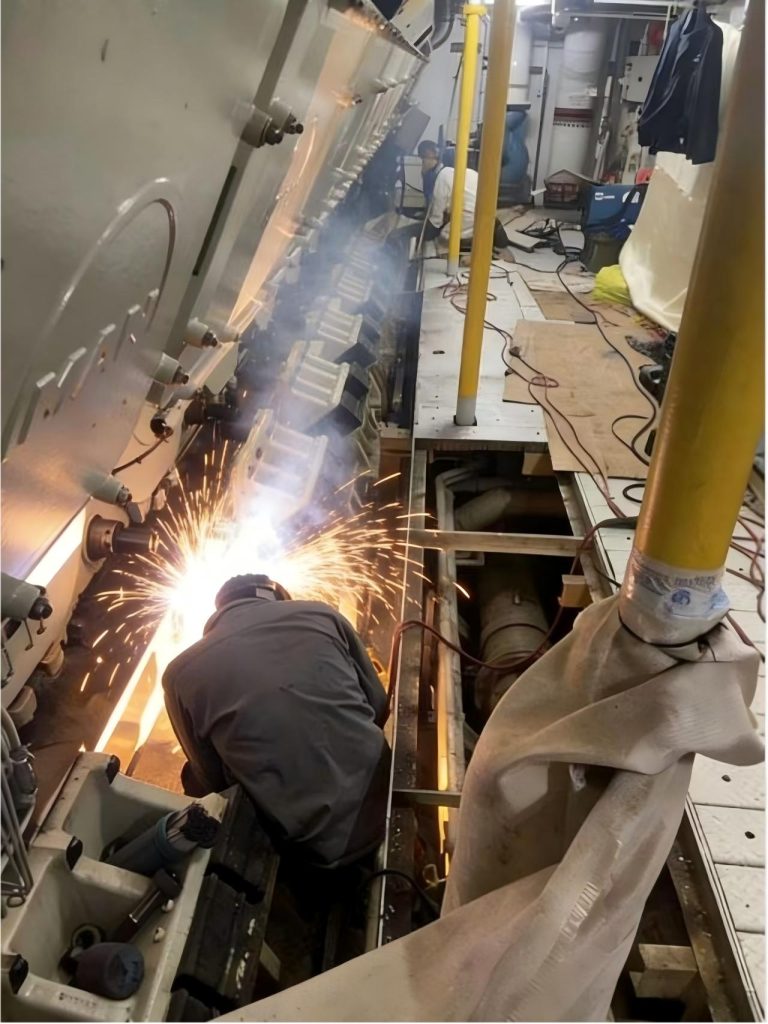
Fit-up and Alignment
After the critical operations were completed, the fit-up and alignment began. Based on the new position of the main engine after adjustment, the relevant bulkhead shaft seals were corrected accordingly; at the same time, the interfaces of the engine’s various connecting flanges, as well as the surrounding piping and auxiliary components, were precisely adapted to ensure that all related spare parts worked in sync with the new state of the main engine and to eliminate additional stress caused by the alignment changes.
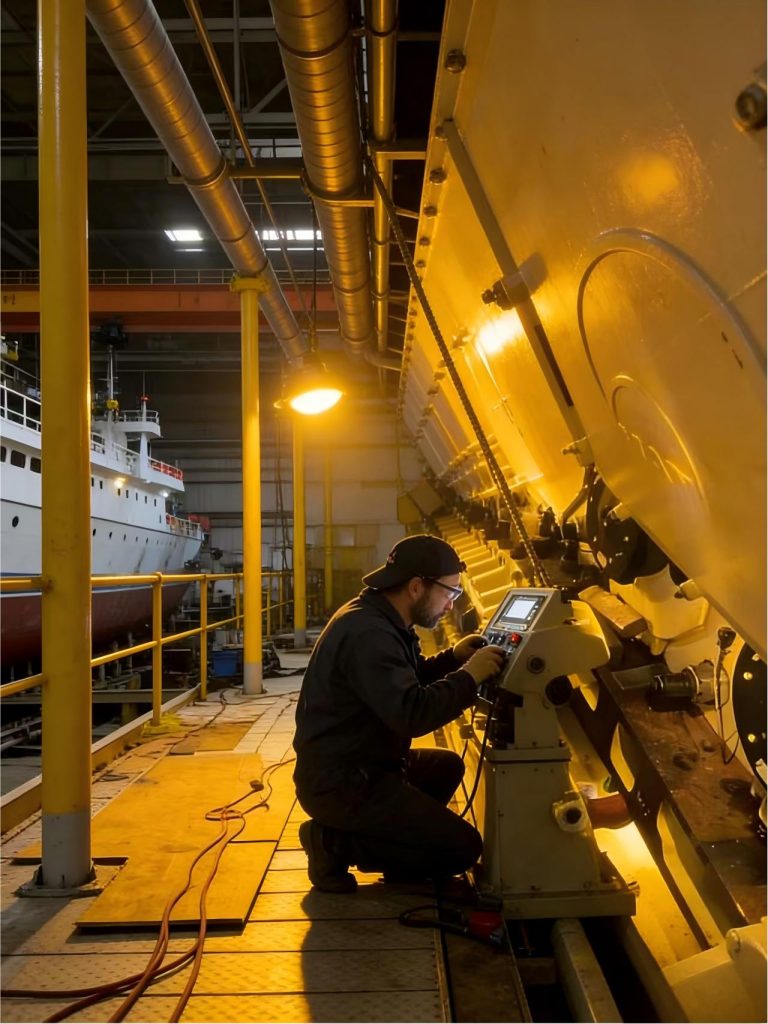
Commissioning and Handover
Finally, commissioning and handover were carried out. After comprehensive no-load and load trials, it was confirmed that the main engine, generator, and key spare parts such as couplings, gasket systems, and flange connections were all functioning normally and their parameters were stable. The main engine then resumed full-load operation. The cruise ship was able to continue sailing without further operational interruptions, and the entire maintenance mission was successfully completed.