Maintain marine diesel engines
2025-11-03
In engine power systems, diesel engines have become the preferred auxiliary power unit for most ships worldwide, due to excellent durability, strong torque, low maintenance costs and greater fuel safety. A properly maintained diesel engine can run continuously for over 5,000 hours before requiring major overhaul, which shows its reliability. To achieve this, the shipowner must have a comprehensive understanding and maintenance of the engine system.
Diesel engines apply compression ignition method, which generates a lot of heat during running and requires effective cooling and heat dissipation. So diesel engines require a water cooling system.
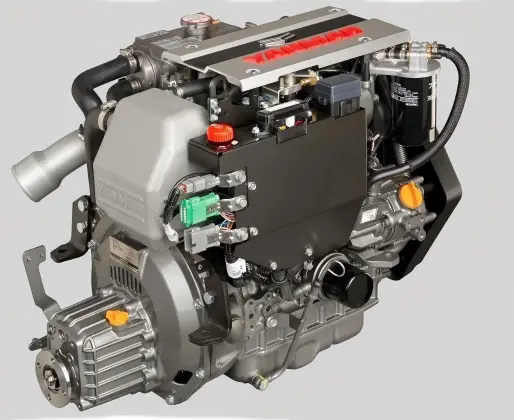
water cooling system
The complete diesel engine water cooling system includes an open seawater loop and a closed freshwater loop. Totally two water cooling systems.
In a closed freshwater loop, coolant containing antifreeze flows inside the engine, passing around high-temperature components such as cylinders, absorbing the heat generated by combustion.Then the heated coolant is pumped to a heat ex-changer where it transfers heat to the seawater circulation system.Meanwhile, the open seawater circulation system draws seawater from outside the ship and allows it to flow through independent pipes of the heat ex-changer.During this process, seawater exchanges heat with high-temperature freshwater without the two liquids coming into contact. The seawater that has completed its cooling task is eventually discharged back into the sea, achieving continuous heat dissipation.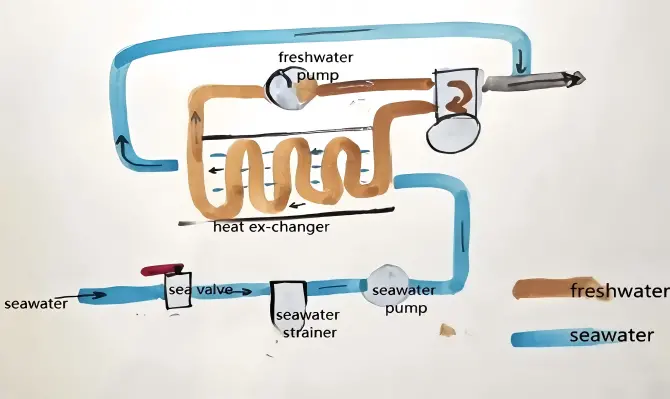
Seawater cycle components: Sea valve,Seawater strainer,Impeller pump,Heat ex-changer,Exhaust water.
Seawater enters the engine through the sea valve, which should remain open when the engine is running (The handle is parallel to the pipe to indicate it is open). Then,the seawater passes through a filter to remove impurities such as algae. After that,the impeller pump propels the seawater through a heat ex-changer and the heated seawater is eventually discharged overboard through the wastewater outlet.
Maintenance: Due to the corrosive nature of seawater, it is recommended that the impeller pump be replaced annually. After engine starting, check the stern for wastewater discharge to ensure that seawater flows normally into the heat ex-changer and cooling the fresh water effectively .
Freshwater cycle components: Freshwater,Antifreeze,Heat ex-changer,Thermostat,Cycle to the hot water heater,Freshwater pump,Reservoir.
The freshwater cycle is actually a mixture of fresh water and antifreeze. Because it flows over the outside of the engine cylinder block, cooling the metal and oil of the engine moving parts, it needs the anti-corrosion components of the antifreeze.The thermostat is in charge of monitoring and regulating the water temperature to ensure that the engine is always at the best operating temperature.This system can also be used to produce hot water for life ----just start the engine in advance and use the circulating heat to heat water for life .
Maintenance: check the water level in the reservoir regularly, observe the wear of water pipes and adjust the tension of the belt driving the water pump. It is recommended to always have spare parts such as belts, water hoses, antifreeze, and thermostats on board in case of emergency.
Diesel fuel system
Diesel fuel system components: Fuel fill plug,Fuel tanks,Fuel petcock valve,Primary water separator,Mechanical fuel pump,Secondary fuel filter,Injector pump,Injector,Return line,Diesel fuel.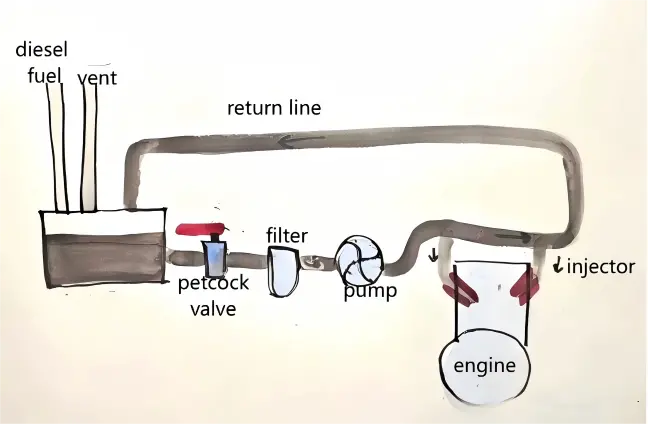
90% of engine failures are caused by diesel contamination.It is imperative to use pure diesel and keep the fuel tank full to prevent condensation and microbial growth.The diesel fuel system ensures stable operation of engines through multiple purification processes.Diesel enters the water-oil separator through the tank discharge valve to remove water.Then being delivered to the high-pressure oil pump after deep purification by diaphragm pump and filter.The high-pressure oil pump pressurizes the diesel and atomizes it through the injector for combustion. The unused diesel is recycled through the return oil pipe.If the engine makes a crackling noise, check the fuel system immediately.
Maintenance: Check the oil-water separator and make sure there are no leaks in the entire system. Spare parts should include a filter and a pump.
Diesel engine lubrication system
It includes oil fill,oil filter,dip stick,oil receptacle tank.
Engine oil is the lubricant in diesel engines, effectively reducing piston friction and support heat dissipation.Since the oil in a diesel engine is subjected to high temperature and pressure, it is normal if the oil is black when checking the oil level with the dipstick.
Maintenance: If the engine oil is bubbling or very cloudy, it may be mixed with diesel or water.Generally speaking, the engine oil should be changed every 100 hours.Keep engine oil and filters on board.
Diesel engine inspection
When sailing, the engine should be checked and performed routine maintenance everyday.Here's a mnemonic to remember all the places need to be checked: I WOBBLED U!
I - isolate: Isolate the engine battery to prevent short circuit caused by accidentally starting the engine;
W - water: Check whether the sea valve is open, clean the filter, check whether the engine's freshwater/antifreeze level is normal;
O - oil: Using the dipstick to check if the oil level in the gearbox is appropriate;
B - belts: Check belt tension and wear;
B - bilge: Open the bilge hatch and check if there is any leakage from the engine, including seawater, oil, or fresh water/antifreeze;
L - leaks: Check pipeline leakage;
E - electrics: Make sure all wires are connected well and the insulation material wrapping the wires is intact.Check the battery charge status after reconnecting the battery;
D - diesel: Check the diesel quantity in the tank;
U - unisolate: Reconnect the engine battery after closing the hood.
Before starting the engine, check for any ropes on the deck that have fallen into the sea to prevent them from getting tangled in the propeller. After starting the engine, observe for at least 30 seconds to see if there is a stream of wastewater gushing out from the stern. Each diesel engine has its own speed range, so avoid running it too fast.Normally, 3000 rpm is the fastest speed for short-term operation,while 2500 rpm is the fastest speed for long-term operation.
Generally speaking, there are only a few problems with diesel engines. If the engine runs but won't ignite, it's most likely a fuel problem. If the engine won't run, it's probably an electrical issue.
Brief Analysis of MAN B&W ME and Wärtsilä RT-flex EFI Main Engines