
Biogas Project Capacity Planning and Generator Selection Guide
[kadence_subtitle]
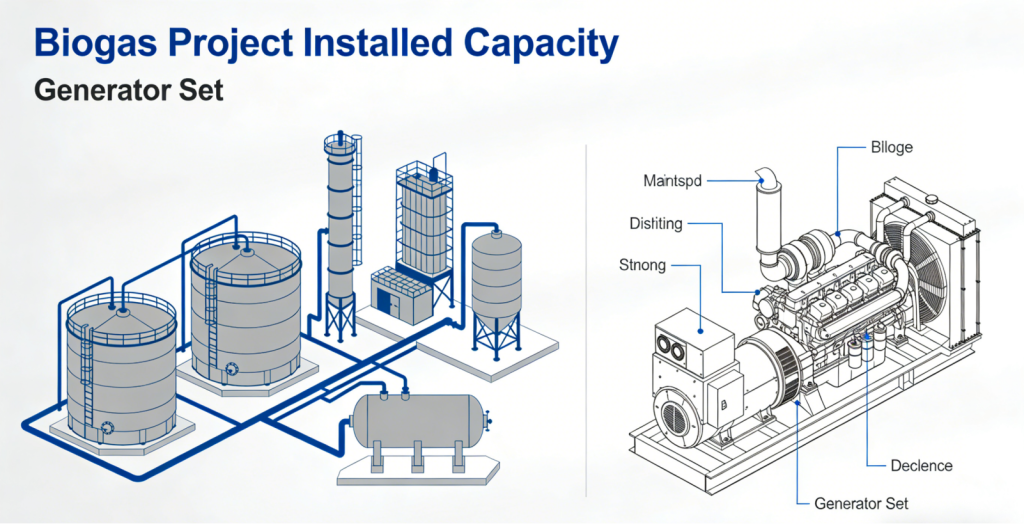
Total capacity
If the raw material supply is stable and the production process is controllable, the methane content and gas production of biogas will stay stable with little fluctuation. That way, we can figure out the total capacity of the biogas power generation project.
NY/T 1704-2009 Technical Specifications for Biogas Power Plants
The capacity of the power plant should be calculated based on biogas production and its lower heating value using the following formula:
P = k(V*H/G)
P = total installed capacity in kW
k = comprehensive ratio coefficient between installed capacity margin and generator efficiency, ranging from 1.08 to 1.20 depending on project requirements
V = maximum hourly biogas production converted to standard conditions, in m³/h
H = lower heating value of biogas, in kJ/Nm³
G = generator heat rate, in kJ/(kWh)
In practice:
V is commonly expressed as daily production (m³/d).
H is commonly expressed as methane concentration.
G is commonly expressed as generator efficiency.
So the formula becomes: P = k((V/24)*(H*35800)/(35800/10/G)Simplified: P = k(V*HG10)/24
Let’s apply this formula with some real numbers. Take biogas production as 10,000 cubic meters per day. Biogas methane concentration is typically between 55% and 60%, so we’ll round it to 60%. Imported biogas generator sets generally have efficiency above 40%, with little variation, so we’ll use 40%. Ignore the margin coefficient for now—set it to 1.
P = (10000 * 60% * 40% * 10)/24 = 1000kW
Single unit power
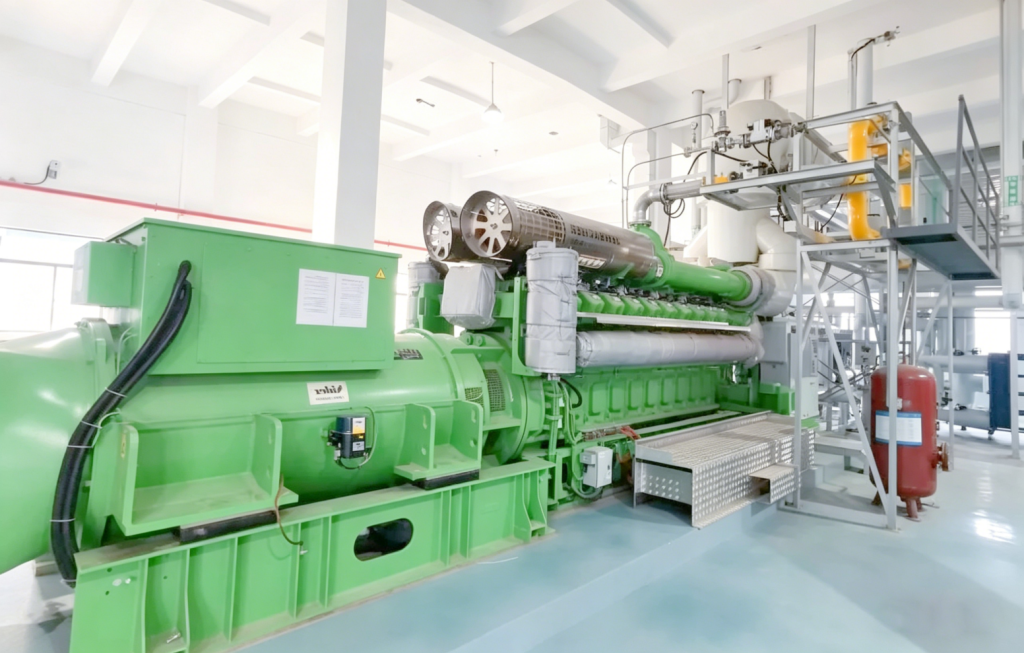
Once the total installed capacity is determined, the next step is to select the unit power output. Taking a 3MW project as an example, possible configurations include one 3MW unit, two 1.5MW units, three 1MW units, or six 0.5MW units, among others.
There is no single, absolutely optimal configuration. From the user’s perspective, selection requires a comprehensive consideration of project investment costs and economic returns. Equipment suppliers, on the other hand, focus more on marketing their own products, and the two parties’ priorities often differ. Additionally, users may consider factors beyond technical and economic ones in their actual decision-making.
The smaller the power output of each generator unit, the more units are required, and the greater the system’s operational flexibility and adaptability to fluctuating or special operating conditions. However, this also increases the complexity of operation and maintenance management, and total project costs may rise as well.
During the unit selection phase, two types of abnormal operating conditions need particular attention. First, insufficient biogas production—such as during the start-up phase of the anaerobic fermentation system, raw material shortages, or production process abnormalities—which may prevent the generator units from running at full capacity. Second, a single unit shutting down for fault repair or routine maintenance, which could result in wasted biogas being flared.
To address the issue of insufficient biogas production, multiple units can be configured in parallel. When gas output is low, some units can be shut down, which improves the operating efficiency of the remaining units and reduce operation and maintenance costs. Some projects adopt a phased commissioning approach during the early planning stage.
To mitigate the risk of unit downtime due to faults, the solution lies in properly sizing the gas storage tank capacity and the individual generator unit capacity. According to relevant biogas power generation specifications, under continuous generator operation, the effective volume of the gas storage device should be no less than the biogas consumption for two hours at the total rated power of the operating units.
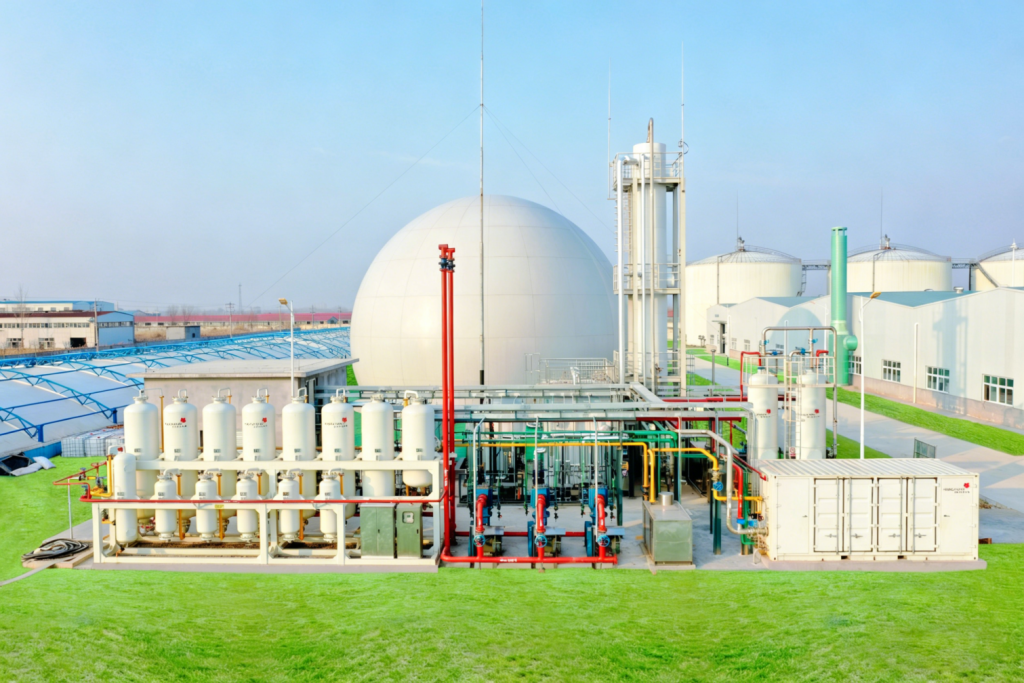
For larger biogas power generation projects, installed capacity is typically in the 2–4MW range, with associated gas storage tank volumes between 2,000 and 5,000 m³. Larger tank volumes provide stronger buffering and regulation capacity against fluctuations in biogas production. During stable operation, biogas storage levels are usually maintained at 50–60%. A 3,000 m³ storage tank can meet the gas demand of a 1MW unit for 3–5 hours of downtime, which covers the maintenance and repair cycle for routine minor faults.
The calculation formula above includes an installed capacity margin coefficient k, which is typically taken as 1.08–1.20 in engineering practice. The main purpose of this margin is to improve system operational flexibility by appropriately expanding the installed capacity. When a single unit experiences a serious fault and cannot be brought back online quickly, the surplus capacity can take over the load, avoiding large-scale biogas flaring. At the same time, keeping units in a derated operating mode during normal operation also helps reduce equipment failure rates and improve overall reliability.
Based on engineering experience, the number of generator units in a biogas power generation project is typically between two and four. For a 3MW project, two 1.5MW units or three 1MW units are both reasonable choices. If project investment conditions permit, a configuration of three 1.2MW units or even four 0.8MW units is also feasible. The final determination of unit type and quantity needs to take into account project cost, unit efficiency, and the owner’s decision-making preferences, among other factors.
Special circumstances
For plant expansions or situations where a unified model cannot be used due to objective constraints, priority should be given to configuring generator sets from the same series. Comparing with diesel engine and natural gas engines, biagas engine is normally sensitive with part quality. For example, Jenbacher J412 and J420 units, or MWM 2020V12 and 2020V16 units, units from the same series offer high commonality in maintenance procedures and spare parts inventory, which can effectively reduce the difficulty of operation and maintenance cost efficiency .